Wednesday, October 31, 2012


What happened in the beginning and what happened in the end were the same. People started playing music and dancing to the beat. It made it feel like nothing in between even really mattered at all in the end. All that mattered was the music, the beat, and the dance. Which makes sense, considering over half the movie had that continuous beat playing in the background. Why was that the central focus though?

There is obviously a pretty straight-forward connection between this plot and the Greek myth about Orpheus and Eurydice. So why portray it in this way? Why with music and dance at the heart? It took me back to the carnivalesque theory we talked about in class. The whole film is a dance between two differing subjects: joy and sadness, life and death, love and hate, frivolity and humility. And just like in a real dance, there is no “winner” out of the two partners; they both dominate at different times and yet work together to create one whole revolving masterpiece. A perfect song about just this concept is “I Hate You Then I Love You.” Quite humorous in my opinion:
http://www.youtube.com/watch?v=Q_Y0tC31VcA

 There is this natural dance and beat that we all feel in life. We’re dancing with the opposites that life brings, with the good and bad of every day. There’s no stopping it. Just like the beginning and ending of this film portray, the dance is eternal. It’s never over.

Wednesday, October 24, 2012


“While others more foresighted than they had got their money out of Santo Domingo and had gone to New Orleans, or were starting new coffee plantations in Cuba, those who had salvaged nothing reveled in their improvidence, in living from day to day, in freedom from obligations, seeking, for the moment, to suck from everything what pleasure they could find” (Alejo Carpentier, The Kingdom of This World, 76-77).
This sounds like a pretty nice concept—to get the most out of life that you can, just living up every moment to its fullest—as opposed to the people who take the more responsible route and try to get their lives in perfect order and harmony. As I was thinking about these two different views on life I couldn’t help but notice that these two views are usually what the two main characters in almost every movie ever made have. One of the characters is the responsible one who has a routine and order in their lives. The other character lives day by day and tries to have as much fun as they can while living it. Basic plot: they meet, they can’t stand each other, they start to like the other point of view, they fall in love or begin to see eye to eye and live happily ever after.

Why do we find such joy in this? How can we watch movie after movie or read book after book about this same exact situation? Why are they so central to life? I’m no expert, but having these differing personalities is what runs the world. If we were all straight-laced and never stepped aside from our order we would never invent new things, try different concepts, find all the joy available in life. On the other hand, if we were all care-free it would be a miracle if anything actually got done that needed to get done.

Balance is the key. It’s as soon as that balance starts dying that things get out of hand in life. But if they’ve already started to get unbalanced like in Carpentier’s book, how do you bring it back to balance?

Wednesday, October 17, 2012


“In literature it is only necessary to outline the steps. Let the people dance!” (Anthony Kerrigan, Introduction to Ficciones, 10).
Sometimes I feel as though people read way too much into things. I’ve always had the thought, “what if the authors really didn’t mean anything when they wrote it? What if they just wanted to watch everyone else interpret meaning into a meaningless story, poem, etc.?” This quote feels exactly like that to me…

The authors can make up whatever “steps” they want! Make it as ridiculous and impossible as they want! They don’t have to actually dance the dance. They get to watch us as we awkwardly try to follow in their written footsteps.

For example, I found this on-line:
A Meaningless Poem
Sounds
When they follow you like dogs
In the forest of silence,
Itch-afflicted, skeletal loneliness
When it litters
Offspring of dreams
In shallow ponds of evenings;
The crows perched
On branches of the sun
Then fly away. 
By Naseer Ahmed Nasir

As I started reading it I just thought of how ridiculous it was. It makes absolutely no sense! But then somewhere deep inside my humanities brain there is a voice that says that there has to be some sort of meaning in this. It can’t really be meaningless! That has meaning in and of itself, right? The fact that it’s supposed to have no meaning? But then my mind again goes to the little detail that the author just won by getting me to think that at all; he got to watch me dance his nonsense dance right in front of him! How embarrassing…
So can there truly be something that has no meaning? Are our minds so intent on putting a label on everything that we can never let something just be? And if so, why do we have to give it meaning? And can there ever be just one “right” meaning?

Wednesday, October 10, 2012

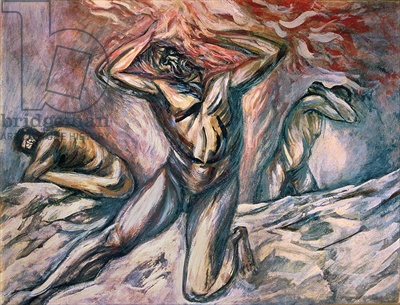
 Jose Clemente Orozco’s Prometheus painting in Mexico.
 
What initially drew me to this painting was the title. In my Greek and Roman Mythology class we talked a lot about Prometheus and how he stole fire from Zeus and brought it down to earth. I found out that Orozco did a mural of almost this same thing earlier that same year in the United States.
Jose Clemente Orozco’s Prometheus mural at Pomona College in California.
  
So, why are they different? Well, for Orozco everything that he painted had a reason, and not merely to look cool. The fire Prometheus stole usually represents wisdom or new knowledge (which seems fitting for a mural at a college). In the mural there is a good mix of people reaching for and embracing the fire and people looking away from it in fear. In the painting, there are only two other people and they are cowered in fear. Again, what is that supposed to mean? Wouldn’t people be so excited to have more knowledge and wisdom?!
At this point, the Mexican Revelution had just happened. Although many thought the revelotion was wonderful, Orozco saw it in more of a different light in that it brought about some great changes but with some bad consequences.  The sense of this painting is exactly that—with the good comes the bad; it’s not always strictly the good OR the bad.
I think a lot of times in life we want to label an event that happened in our lives as a good thing or a bad thing. The fact is that all of these “things” whether good or bad have equally significant meaning in our lives in both good and bad ways. It’s important to step back and take a look at how these “good” and “bad” events are actually shaping our lives in ways we didn’t realize; we need a dose of pserspective.


Wednesday, October 3, 2012


“But a humane social order is not always achieved without the grotesque, and sometimes not without the cruel” (Joaquim Maria Machado de Assis, Father versus Mother, 89).

The minute I read this my mind flashed back to the movie The Prestige. It went specifically to near the beginning of the movie when they are at a magic show and see the trick of the vanishing bird cage. You find out later the way they did it was through killing the birds in a collapsible bird cage.

Going to a magic show is a perfectly acceptable form of entertainment. Everyone loves watching amazing, seemingly impossible feats become possible right before their eyes. To keep up with this natural societal order of watching magic they on occasion used some “grotesque” methods to keep ahead in the game.

But how could that still be considered “humane” as Machado states? Part of me thinks we desensitize ourselves as a people. One person calls something normal that may not be quite so normal, and everyone believes him because they want to enjoy whatever he called normal. For example, people liked watching the bird cage disappear and decided it had to be fine then. It’s all about fitting in, about being in the social “norm” of things.

Another part of me thinks it has to do with the fact that everything has its opposite. Maybe we need the “grotesque” and the “cruel” to know when something actually is humane and decent. Without it, there is no way to measure the difference or the progress.

So does Machado’s statement actually have hints of truth laced in it, or is it yet another one of his overtly sarcastic remarks?

Wednesday, September 26, 2012


“He then separated himself from her in order to have the pleasure of returning to her” (Jose de Alencar, Iracema, 77).
How often do we do this in life? We love something so much that after we are with it for a bit we put it back in its box, or room, or wherever it came from just so we can come back to it later and love it just as much as the first time we were with it? For example: a delicious chocolate cake.

You eat a piece of it and love every bite. Then you put it away for a while and come back to it later to enjoy yet another wonderful piece of chocolate cake. You find yourself doing this again and again because it is just that amazing! If you ate the whole cake at once the joy and deliciousness of it would wear off and even have the risk of becoming loathsome to you.

Some would say that is too much of a good thing...
On the other hand we have the Mexican painter Jose Maria Velasco who was born and raised in Mexico and painted the valley of Mexico countless times, always finding new aspects of beauty and wonder in the landscape around him. He never seemed to tire of that valley.

So what makes the difference? Are some people born with that feeling of the need to change, keep moving on to new things, or do people chose that kind of a mentality? And if you are born with a certain outlook, can you change that perception with time or is it simply too ingrained in your nature?

Is there any real way to find out?

Wednesday, September 19, 2012


“The honey of Iracema’s lips is like the honeycomb which the bee makes in the trunk of the Guabiroba: poisonous is its sweetness” (Jose de Alencar, Iracema, 26).

Iracema the Guardian
All throughout history we hear/read/watch things about a beautiful woman who has a dangerous secret within her that usually ends, inadvertently or not, in tragedy, grief, pain, etc. Iracema is a classic example of this. As also is Pandora. They are both seen as women “born” from nature in a way. Iracema is the essence of nature, and Pandora was created by the gods from the earth. They both innocently bring sadness into the world, Pandora with her box containing all the evils of the world and Iracema betraying the secret of the Jurema. Yet in spite of the sadness they bear children who become the principle people of new nations. Out of tragedy comes miracles; out of death comes life.

Pandora's box

 
This brings me to the question of why we see this pattern so often in history. As Octavio Paz put it, “woman is a living symbol of the strangeness of the universe…the supreme mystery” (The Labyrinth of Solitude, 66). Women are confusing; they are a mystery to the world. No one quite understands them which I think is what makes them such great characters to portray. There is this quest to find out if they really are perfect through and through as their beauty portrays or if there is something deadly within them just below the surface.

 
Being a woman, I think it is safe for me to say that there is more to a woman than meets the eye. I am positive that this topic will continue to be seen in different mediums as time ticks on. This shows just how influential women really are that authors, artists, and directors will still continue to try and solve this great unsolvable mystery known as the woman.